Showing posts with label dress and fashion. Show all posts

Monday, 13 February 2012

La Belle Assemblee: creating a new type of magazine

La Belle Assemblée, or in full La Belle Assemblée or, Bell's Court and Fashionable Magazine Addressed Particularly to the Ladies, was a British women's magazine published from 1806 to 1837, founded by John Bell (1745–1831).


La Belle Assemblée was a landmark in the history of magazine production and a testimony to John Bell’s talent in raising the standards of magazine production. Bell believed a periodical needed to appeal visually and the lavishness of La Belle Assemblée marks it as the ancestor of modern glossy magazines. Leigh Hunt, the Romantic critic and poet, described Bell’s innovations in typography as ‘elegant’; the layout and illustrations were equally fine and produced in a format larger than other contemporary magazines, such as the Lady’s Magazine, and much larger than the pocket-sized Ladies’ Monthly Museum.

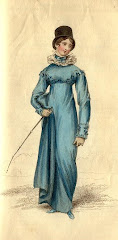
La Belle Assemblée is now best known for its Georgian fashion plates but until the 1820s it also published original poetry and fiction, non-fiction articles on politics and science, book and theatre reviews, and serialized novels, including Oakwood Hall by Catherine Hutton. Another notable contributor to La Belle Assemblée was Mary Shelley, and works by both of these authors can be found in the collections here at Chawton House Library.

Each number of La Belle Assemblée typically contained five plates—one depicting a member of the court or fashionable society, two depicting the latest fashions, and a further two providing sheet music and a sewing pattern—the magazine was not dominated by the frivolities of fashionable dress. Bell separated the portion of the work dealing with the fashions of the month from the remainder of the publication. Initially the two sections could be purchased separately; the first consisting of the bulk of the letterpress, together with two of the plates, the second ('La Belle Assemblée') consisting of the fashion plates and a sewing pattern, together, usually, with four pages describing the plates and discussing the latest London and Paris fashions. The presentation was meticulous and for the first few numbers each section was bound in a bright orange wrapper and with engraved title pages.


Wednesday, 22 July 2009

Chawton House Library Books - a new series of reprints

Chawton House Library houses a unique collection of early women’s writing from the period 1600–1830. Housed in the Elizabethan manor that once belonged to Edward Knight, it is a library with a direct connection to his celebrated sister, the novelist JaneAusten (1775–1817) who moved to Chawton with her mother and sister in 1809. The library contains early (and frequently rare) editions of novels, plays, memoirs, poetry and travel writing by women, as well as works on education, history, science and botany. One fascinating section of the collection offers literature pertaining to women’s lives in the long eighteenth century: cookery books, guides on how to manage domestic servants and setting down exactly what is required of a lady’s maid, how to dress and educate one’s children, instructions on how to behave and what to read to improve oneself. It is this area of the collection that this series will celebrate. Jane Austen’s interest in the domestic in her letters to her sister Cassandra has enchanted generations of her readers. Writing from Chawton, Austen rejoices in a great crop of Orleans plumbs, whilst lamenting the wretched appearance of Cassandra’s mignionette, and relating that Miss Benn has a new maid from near by Alton; she tells her sister that they will have ducks next week, and enquires after ‘peices for the Patchwork’; she says of their cook that she is ‘tolerable’ and that ‘her pastry is the only deficiency’; she approves Fanny and Cassandra’s bonnets, and tells of her pleasure in ‘receiving, unpacking & approving our Wedgwood ware’. Austen’s letters to Cassandra are a rich source for piecing together female domesticity in the early nineteenth century. One can, however, have too much of a good thing: Austen famously writes, after a visit from her brother Edward to Chawton in September 1816, ‘Composition seems to me Impossible, with a head full of Mutton Joint and Rhubarb’. Austen’s major preoccupation at Chawton was, after all, not the running of a household, but rather the publication, revision and composition of her six novels, all of which were sent out from Chawton to be published between 1811 and1818. In these classic works of English literature, the way in which the domestic informs the narrative intrigues a twenty-first century reader. Would Betty’s sister, an excellent housemaid who works very well with her needle, have done well as a lady’s maid for the Dashwoods in Sense and Sensibility? Can we ever have such an intricate understanding of the variety and merits of strawberries as the party at Donwell Abbey in Emma? It is to the literature of Austen’s own period that we must turn for answers to these, and many other, vexing questions. For those who wish to understand Mr Woodhouse’s discourses in praise of gruel in Emma, Mrs Bennet’s anxiety when there is not a bit of fish to be got and Lizzie Bennet’s preference for a plain dish over a ragout in Pride and Prejudice, these reprints of rare texts from the Chawton House Library collection will have much to offer. What precisely were the ‘usual stock of accomplishments’ taught to Henrietta and Louisa Musgrove at school in Exeter in Persuasion, and why does Lydia gape at Mr Collins’s reading of Fordyce’s Sermons in Pride andPrejudice? Some answers will be found in Chawton House Library reprints of conduct literature. And for a true understanding of what it might mean for Fanny Price to be scorned by her better-dressed cousins for having only two sashes in Mansfield Park, for Henry Tilney to understand muslins particularly well in Northanger Abbey, and indeed just how Lucy Steele might have gone about trimming up a new bonnet, with pink ribbons and a feather, in Sense and Sensibility, instruction will come from reprints of works on eighteenth-century dress and fashion. All profits from this series of reprints will go directly towards the Chawton House Library acquisitions fund, helping us to improve and expand the library collection for generations of future readers.

Gillian Dow
Chawton House Library